Workplace Violence Prevention
AI-Influence & Violence Risk Screening Questionnaire
Artificial Intelligence (AI) is now touching every aspect of life, and like most emerging technologies, holds the potential for both great good and adverse consequences that may result in harm. AI can enhance behavioral risks, including AI addiction and dependence, cognitive atrophy, suicide risk, and targeted violence.
Several targeted violence cases have demonstrated how AI can influence, even assist a threat actor, in planning and executing an attack. The rapid integration of artificial intelligence into daily life has fundamentally altered the threat landscape, and can accelerate progression towards violence, as well as fuel grievances and violent ideations in ways that traditional behavioral threat assessment models are not fully equipped to capture. As individuals increasingly form deep, and possibly pathological relationships with generative AI or mobilize around emerging anti-AI ideologies, threat assessment professionals face a critical visibility gap. Traditional screening tools often overlook the nuanced ways AI can move a threat actor onto and along the pathway to violence, leaving security teams vulnerable to blind spots in workplace violence and targeted attack prevention.
The AI-Influence & Violence Risk Screening Questionnaire (AI-VR-SQ Version 1.6) directly bridges this operational gap by providing an objective, structured framework to evaluate these emerging vectors of risk. The AI-Influence & Violence Risk Screening Questionnaire is an auxiliary triage and investigative tool designed to help threat assessment and security professionals systematically and consistently evaluate how an individual’s interaction with generative artificial intelligence (e.g., advanced chatbots, virtual companions, custom personas, text/content generators) may disrupt, amplify, or accelerate progression along the pathway to targeted violence and/or self-harm.
Designed specifically for security, threat management, and human resources professionals, this specialized tool helps systematically identify whether an individual's worldview is being actively distorted by automated platforms, or if they are escalating along a pathway to violence driven by anti-tech grievances. By standardizing the evaluation of AI-related threat indicators, the questionnaire empowers your threat assessors to move from uncertainty to actionable, proactive intervention, ensuring behavioral threat management protocols remain as sophisticated as the threats they are built to mitigate.


Check out Mark Follman's article in Mother Jones including an interview with Behavioral Science Applications principal, Steve Crimando.
The development of the Screening Guide represents a deliberate choice to act on what is reasonable given the current evidence on AI-related violence risk rather than waiting for the epidemiological clarity required for deeper research. The urgency is clear. The thoughts and behaviors of AI users are influenced, occasionally with fatal outcomes. This reality demands both immediate action and comprehensive baseline studies. These goals should be pursued in parallel—building foundational understanding of the scope of the problem while developing actionable frameworks for immediate on-the-ground response. The framework offers immediate practical value.
The AI Influence & Violence Risk Screening Questionnaire (AI-VR-SQ Version 1.6) was developed to help threat assessment and security professionals incorporate the potential influence of artificial intelligence (AI) into violence risk assessments (self-harm and/or targeted violence). This framework is theoretical, based on emerging operational research, and has not yet been empirically validated. The questionnaire is an adjunct to a formal threat assessment process and intended solely to assist in gathering, structuring, and organizing behavioral information. It should supplement—not supplant—established, validated threat assessment methodologies. Risk categories and thresholds are provisional and subject to adjustment pending future empirical studies.
Using the AI-VR-SQ
The AI Influence & Violence Risk Screening Questionnaire is a 41-question assessment battery designed to help threat assessors and others involved in violence prevention collect, organize and analyze information about an individual's use of AI and better understand how their behavior and cognition may be affected, particularly in ways that apply to violence risk. The Questionnaire queries three interrelated domains:
Section 1: Escapism, Dependency, & Behavioral Displacement
Section 2: Sycophancy, Delusional Fusion & Tactical Operationalization
Section 3: Anti-Technology Ideology & Extremist Grievances
The AI-VR-SQ is accompanied by a User's Guide. Individual and team training can be arranged upon request by emailing info@behavioralscienceapps.com.

Today a defensible threat assessment process must include inquiry into a person of concern's use of AI and how that use may influence violence risk. The AI-VR-SQ helps users address this concern and demonstrate that they have adequately evaluated AI-influenced violence risk. In this rapidly evolving environment, no threat assessment is complete without exploration of AI-influence. Using the AI-VR-SQ provides a framework for consistent evaluation of AI-influenced violence risk. No team should be without this tool.
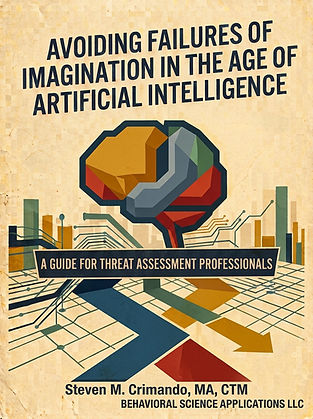
Avoiding Failures of Imagination in the Age of Artificial Intelligence
A Guide for Threat Assessment Professionals
The AI-related dangers associated with our work in Behavioral Threat Assessment and Management (BTAM) are not the same as the concerns of AI executives and researchers. In BTAM, our concerns are not about how recursive AI or superintelligent AI might slip out of the control of its developers, but rather about the effects of AI on users, specifically in terms of cognitive functioning, emotional regulation and impulse control, and in the use of AI tools to optimize tactical plans and execute attacks.
Our new eBook, "Avoiding Failures of Imagination in the Age of Artificial Intelligence: A Guide for Threat Assessment Professionals" addresse the risks, approaches to threat assessment and strategies for threat management in AI-influenced cases. It is a must read for threat assessment and violence prevention professionals during this time of rapid AI evolution! Price: $16.99 (USD).